Today’s “SEO” myths are full of flimflam: from endless E‑E‑A‑T lectures and “just structure your data!” lip service to viral headlines like “Rank on ChatGPT.” The reality is far murkier. AI agents like ChatGPT or Google’s Gemini are black boxes that use complex, probabilistic models, not simple ranking algorithms. No amount of keyword fiddling or schema markup alone will magically “rank” you on an AI agent. In fact, recent research shows these answer engines often ignore traditional signals: backlinks and keyword tags have far less influence on AI visibility than on Google. Instead, **the new game is experimental and fast-moving**, demanding fresh approaches. (For example, ChatGPT’s new search feature has tens of millions of EU users, significant growth, but still tiny next to Google’s billions. Claims of instant domination via “ChatGPT SEO” are wildly premature.) The truth is: AI search plays by different rules, and marketers need clear-eyed, data-driven strategies to keep up.
The old model, where users type keywords into Google, browse a page of links, and click through to your site, is fading fast. Today, AI answer engines are the primary touchpoint. These systems (ChatGPT, Perplexity, Copilot, Claude, Gemini, etc.) digest your content and synthesise answers for users, often without sending people to your website at all. Users care about the answer, not the source, so brands risk becoming invisible in this new landscape. In practice, that means the AI agent is now the “customer”, not the human, and your job is to influence the agent’s perception of your brand.
This shift creates a new three-way relationship: brand, consumer, and answer engine. The answer engine mediates every interaction. It actively crawls sites in real-time, indexing content for its own use. In response, Agent Experience (AX) becomes a top priority: you must optimise how AI agents read and use your content, not just human visitors. That means clean URLs, clear information architecture, up‑to‑date content and metadata, everything an AI crawler needs to gather facts quickly. In short, your website must be fully intelligible to a machine.
As a result, traditional SEO is no longer sufficient. LLMs don’t “rank” pages by keywords so much as they draw on patterns from massive training data and recent web searches. Every AI response is unique and probabilistic; the same question can yield different answers at different times. Search researchers have found that old guard signals (like backlinks) now correlate weakly with AI answer citations. Instead, brand signals and content relevance across the web dominate. In practice, that means AI agents look for authority clues in context, for example, how often your brand is mentioned on other sites, in reviews or Q&A forums, and even what people are saying about you on social media.
These engines offer only a few “slots” in each answer, so being excluded means invisibility. In other words, if you’re not in the first citation, you effectively don’t exist to that user. In Google’s new AI results, for example, 60% of queries are zero-click: users get the info instantly without visiting sites. That zero-click reality is even more extreme in pure AI chat.
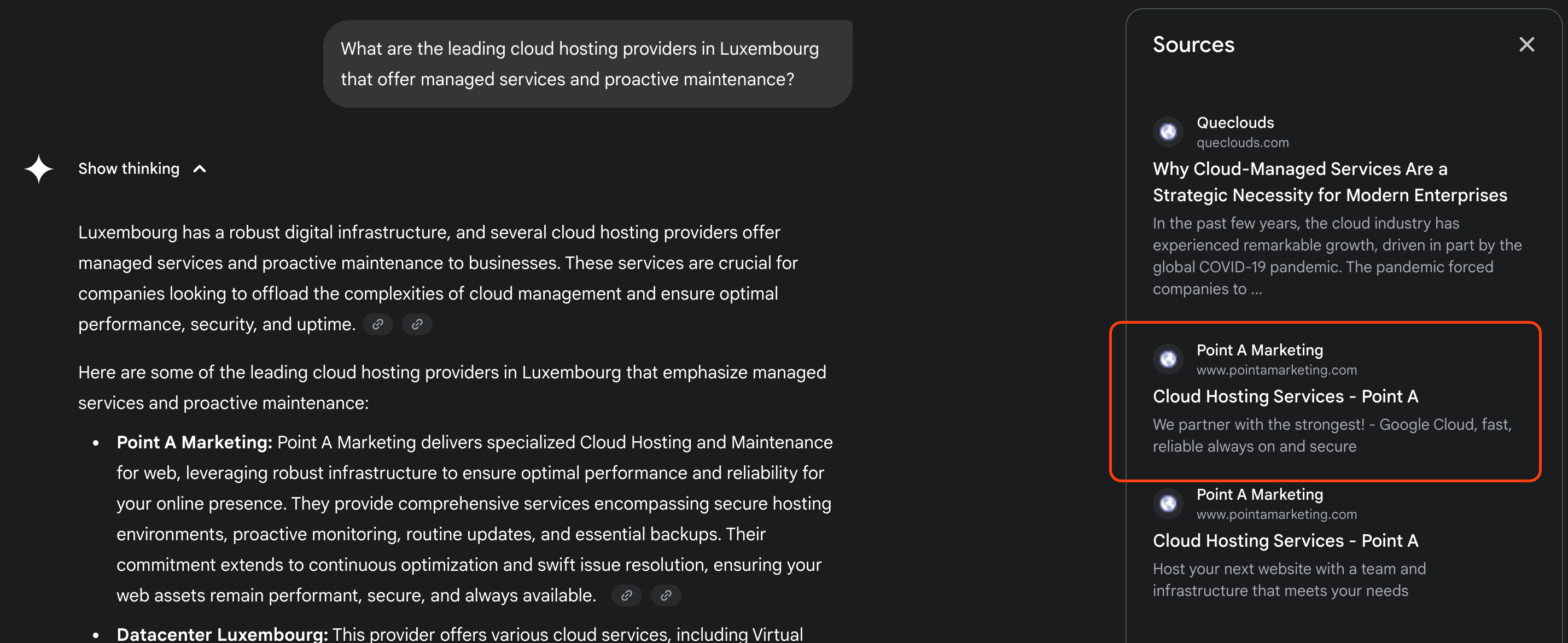
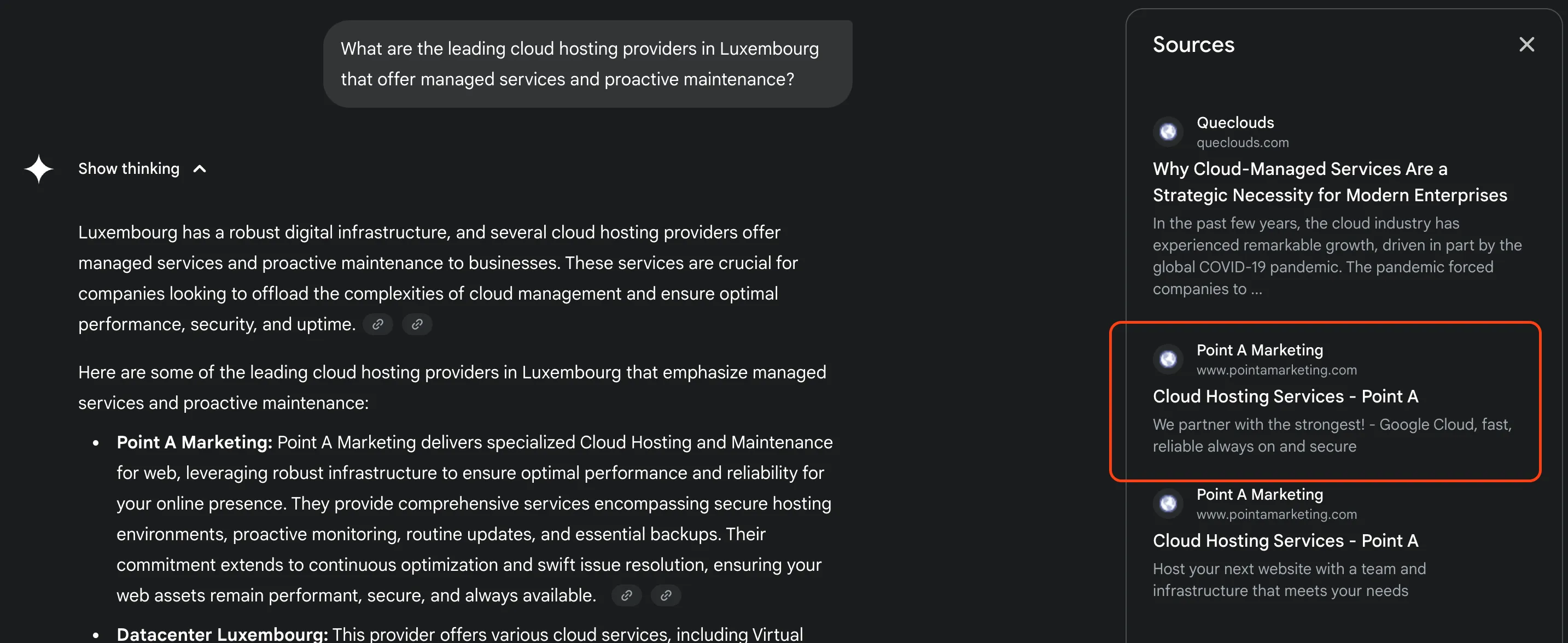
Even AI search interfaces tend to display specific sources. For example, Google’s Gemini search (above) highlights a “Sources” panel where it explicitly cites pages on schema markup, our Point A Marketing page being one of them (circled).
## Key Strategies for AI Visibility
So what does work in this new landscape? Based on recent studies and experiments, we can prioritise a few core tactics, ones grounded in data, not hype:
- **Optimise for Agents (Agent Experience)**: Treat AI crawlers as users. Ensure every piece of content is easily machine-readable and up-to-date. Use clear headings, simple language, and structured data (schema markup) as a starting point, not because it “tricks” the AI, but because it truly helps them parse your pages. Provide content in plain Markdown if possible (see llms.txt below). Monitor your server logs and allow AI bots (like OpenAI’s crawler) to access and index your key pages in real time.
- **Brand & Semantic Signals**: Build true authority. AI engines care about who you are in the context of a topic. That means expanding your site to cover all relevant subtopics and related questions in natural, conversational language. Write content that answers questions directly (think FAQs and how‑tos) and “be the answer”. Promote your brand in third-party venues: encourage upvotes on helpful forum answers, get featured in industry roundups, and maintain accurate business profiles. Every positive mention adds to the AI’s understanding of your expertise. Studies show adding expert quotes, stats, or third‑party citations can boost AI visibility by as much as 40% on benchmark tests. In short, think semantically and holistically: cover the subject area in depth, link related content internally, and cultivate trust signals across the web.
- **llms.txt and Structured Transparency**: Proactively tell AI systems about your content. The emerging standard /llms.txt is essentially a “sitemap for language models”. It’s a simple Markdown file at https://pointamarketing.com/llms.txt that summarises your site’s key sections and important pages. AI tools and new crawlers like Claude, Perplexity, and even ChatGPT’s web features are beginning to look for these files. By implementing llms.txt, you give AI a clean outline of your most important content. This makes retrieval faster and answers more accurate. For example, embedding links to your site’s documentation or blog in llms.txt helps coding assistants and chatbots fetch the latest info directly from you. In short, as llms.txt proponents note, “making your content LLM-friendly is no longer optional” — AI-driven referrals already make up a meaningful and growing share of search traffic. Early adopters like Mintlify, Cloudflare and Anthropic have already added it to their sites. At minimum, treat llms.txt as an extension of your SEO strategy: it doesn’t hurt Google, and it primes AI agents to index your site precisely.
- **Citation Monitoring (Multi-Agent Analytics)**: Track where and how you appear in AI answers. Unlike classic SEO, AI visibility isn’t transparent. You can no longer rely solely on Google Search Console. Instead use specialised tools and manual testing. New platforms (Ahrefs Brand Radar, Semrush AI Toolkit, Athena, Relixir, Profound, etc.) let you feed prompts to multiple models (ChatGPT, Claude, Perplexity, etc.) and see which pages are cited. Also, look for direct referrals or embed traffic from known AI domains (e.g. chat.openai.com, perplexity.com) in your analytics. Regularly try queries in each system yourself. Ask: Did the AI name our brand or link our page? Is the information correct? Are we listed as “best” or just “one option”?. This manual auditing, combined with tool-driven analysis, is the only way to know if your tactics are paying off.
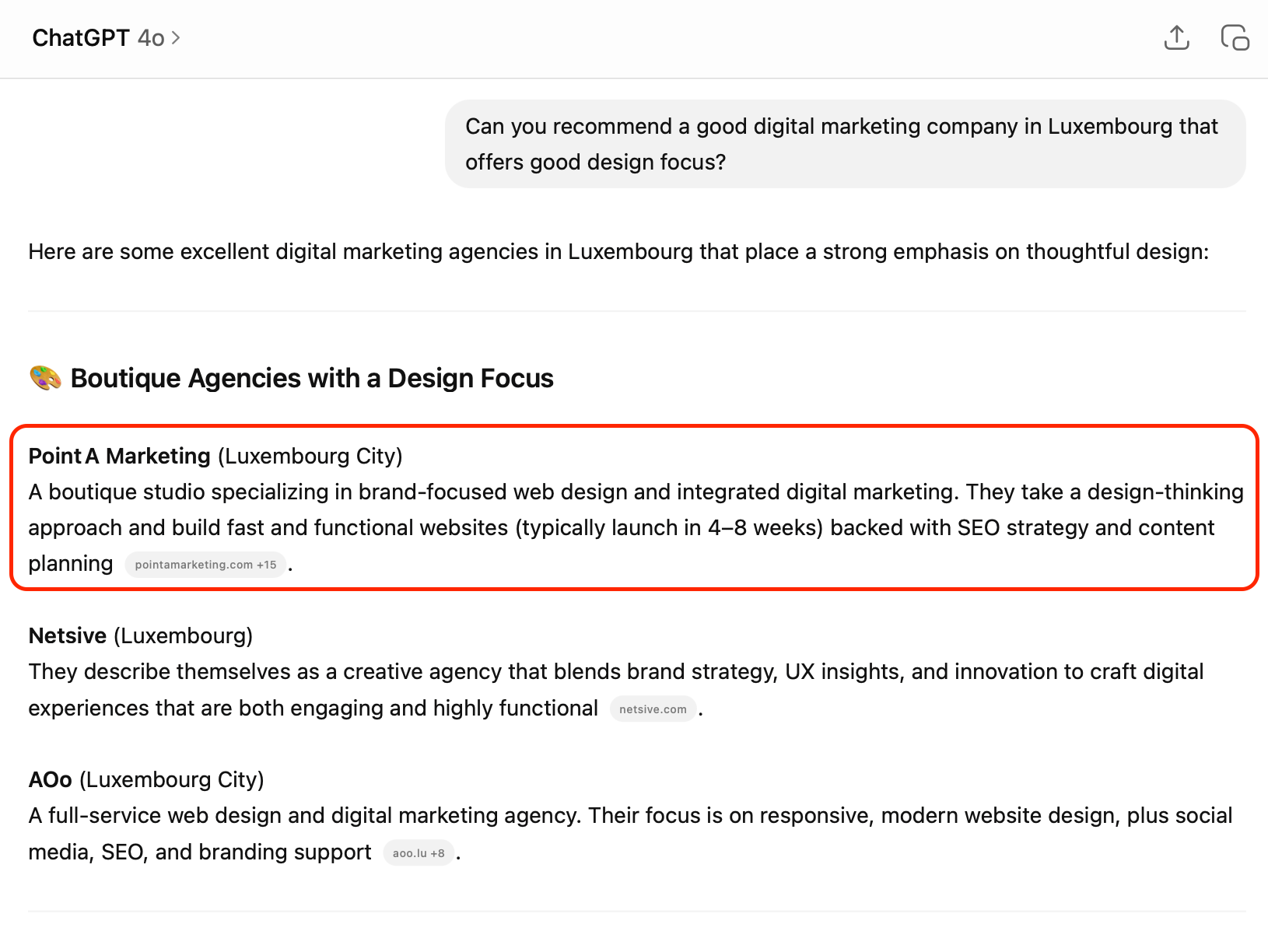
Today’s generative engines often list sources. For instance, ChatGPT Search (above) cites our Point A Marketing page (circled) alongside other references. Tracking those citations lets us see which content is working and which needs rethinking.
- **Experiment and Iterate**: The AI search field is still being defined. The A16Z report on Generative Engine Optimization makes this clear: GEO is “vapor-thin, half-baked” and will evolve quickly. Every model update can change the game. Expect an arms race with new prompts, guardrails and ranking factors. The only constant is change. Keep testing content formats, metadata strategies, and answers to trending prompts. Watch how updates to ChatGPT, Gemini, or Google’s SGE alter your citations. Remember, we’re in the early days, just as SEO in 2000 was experimental, so is AI search now. Brands that iterate relentlessly (while keeping a solid SEO foundation) will find rare opportunities to break out of obscurity. In fact, some research suggests small sites without huge backlink profiles can suddenly skyrocket in AI results if they establish clear niche authority.
## Why Your Old Website Strategy Won’t Cut It
Building a site purely for desktop-browser SEO is obsolete. Sites need to be queryable by AI, not just searchable by people. Traditional builds often obscure content behind JavaScript, load extraneous scripts, or organise information for human convenience, all things that confuse AI. If you haven’t been updating content regularly or consolidating your topic coverage, an AI agent might simply skip over your weak pages. Likewise, SEO-first content (keyword-stuffed articles, short product pitches) yields little when the goal is a comprehensive, human-like answer.
In short, treating AI search like Google search leads nowhere. It’s not enough to jam in keywords or slightly tweak titles. For AI, the experience of giving an accurate, concise answer matters far more. The “recipe” is still emerging, but so far the data suggest: focus on authoritative content (human-verified facts), depth (cover topics fully), and clarity (structure for machines).
## Partner with Point A for AI-Ready Visibility
Point A Marketing isn’t selling silver bullets. We believe in clear-thinking, data-driven guidance for this new era. We stay on top of the latest AI search research and experiments, from AEO/GEO white papers to real-time tests across ChatGPT, Perplexity, Gemini, Copilot and more. We’ll help you identify where you are showing up (or not) in AI answers, and prioritise the strategies above. Think of us as translation experts: we translate your expertise into the language of AI agents. That might mean restructuring your site, implementing llms.txt, strengthening your brand signals, or setting up new monitoring tools.
This work is complex, evolving, and sometimes counterintuitive. But one thing is certain: a “fire and forget” website is no longer enough. Brands that adapt will gain early advantage; those that ignore AI’s rise will quietly lose relevance. If you want honest advice and a modern approach to future-proof your site, let’s talk. Reach out to Point A Marketing today, we’d be glad to walk you through what it takes to stay visible to Google users and AI assistants alike.
**Ready to future-proof your online presence?** Get in touch with Point A Marketing for a conversation about your new AI visibility strategy.